
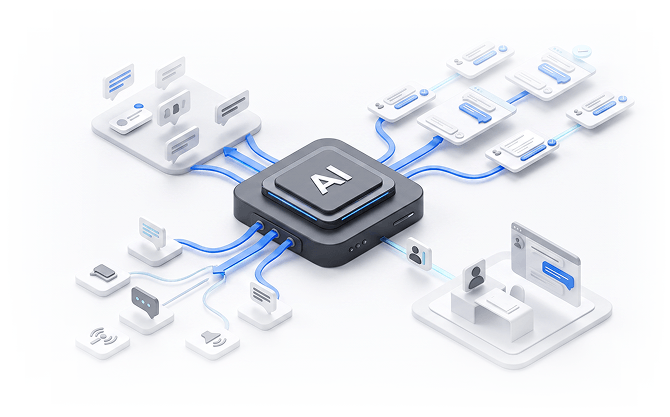
Message & channel context
Automate Complex Customer Conversations
Our AI Chatter is a policy-driven conversational AI system for complex text-based consultations, customer support, sales and user assistance. It maintains dialogue state and interprets conversational signals. It retrieves approved knowledge, invokes permitted tools and returns structured results to CRM and analytics systems.
It is not a generic chatbot governed by one prompt or a fixed decision tree. Each AI Chatter is a multilayer professional persona configured around historical communication and business goal; knowledge boundaries and behavioral policies; channels and infrastructure.

Why does traditional chat automation fail?
- Real conversations do not follow predefined branches
- Generic assistants lack business-specific roles and policies
- Limited context causes repetitive or irrelevant responses
- Valuable conversation outcomes remain trapped in chat history
consumers frustrated by having to repeat information
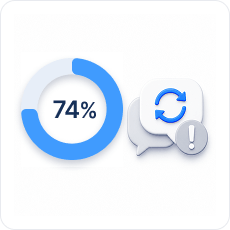
consumers who want support to continue where they left off
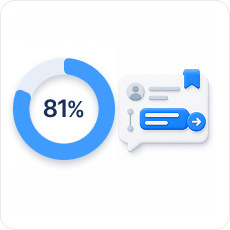
consumers expecting support tailored to prior interactions
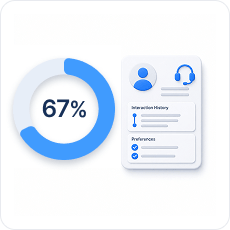
consumers whose purchasing decisions are influenced by response speed and accuracy
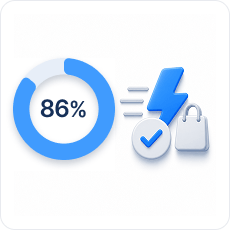
How the AI Chatter manages complex conversations
The same governed conversational layer can support sales, customer service, onboarding and user assistance without replacing the communication channels or CRM systems already used by the business.
Historical dialogue analysis
Real conversations are analyzed for customer intents, terminology and objections; emotional signals and escalation reasons; successful or unsuccessful outcomes. The findings inform the persona, policies and dialogue states, as well as retrieval rules, extraction schemas and evaluation scenarios.
Policy-governed behavior
The Policy Core defines the professional role, personality and business goal. It sets required questions, prohibited assumptions, permitted knowledge and actions, escalation rules and completion criteria.
Context-aware, nonlinear dialogue
The Agentic Core tracks dialogue state and missing information, retaining permitted context. It moves between topics and revisits earlier questions, then selects the next question, policy, tool or conversation path.
Adaptive communication and actions
Intent and signals such as uncertainty, frustration, urgency or hesitation can shape tone, response depth and question order. Permitted APIs can verify data, retrieve statuses, update records and trigger workflows.
Structured business outcomes
CRM and analytics systems can receive customer intent, needs, objections and preferences; qualification data, risk flags and unresolved questions; next steps, confidence values and interaction outcomes.
Channels in. Controlled conversation out
The AI Chatter connects customer communication channels with client-side business systems. A separate operational database spans the flow. It preserves messages, state transitions and retrieved context; system decisions and actions; extracted data and conversation outcomes.
Client inputs
Customer, history & CRM IDs
Workflow, product & metadata
Consent & access status
Conversational AI core
Policy Core
Role, boundaries & rules
Agentic Core
State, decisions & actions
RAG & memory
Knowledge & permitted context
Model routing
Approved models by task
Tools & APIs
Retrieval, verification & updates
Structured output
Response, facts & events
Business outputs
Contextual response & state
Extracted facts & confidence
Actions, escalation & outcome
CRM, BI & workflow updates
Natural dialogue. Structured operational control
The system separates the natural customer-facing dialogue from the structured operational record required by sales, support, management, quality assurance and analytics.
Customer & team experience
Context continuity
permitted facts, customer history and previous results remain available across long and nonlinear conversations
Adaptive communication
tone, response depth, question order and next actions can change according to intent, dialogue stage and conversational signals
Policy-controlled execution
interactions are governed by required questions, knowledge boundaries, prohibited assumptions, tool access and escalation criteria
Knowledge-grounded guidance
responses use retrieved, access-controlled business sources rather than relying only on the model's general knowledge
Operational handoff
summaries, unresolved issues, risk flags, agreed next steps and required human actions are returned in a defined schema
Leadership & analytics view
Reconstructable interaction history
messages, timestamps and dialogue states; retrieved context, model outputs and tool calls; system decisions and outcomes
Operational observability
policy versions and model-routing decisions; CRM updates, errors and retries; completion status and confidence values
Conversation analytics
reports by intent, outcome and objection; product and customer segment; channel and escalation reason
Policy and model evaluation
comparison of response quality, completion signals and interaction results across policy and model configurations
Knowledge and process improvement
recurring questions, unresolved issues and unsuccessful paths reveal knowledge gaps and workflow weaknesses
Understand the
signal. Not just
the message
A literal chatbot reacts only to what the customer says. The AI Chatter evaluates the message together with conversation history, apparent intent, CRM context and the current dialogue stage.
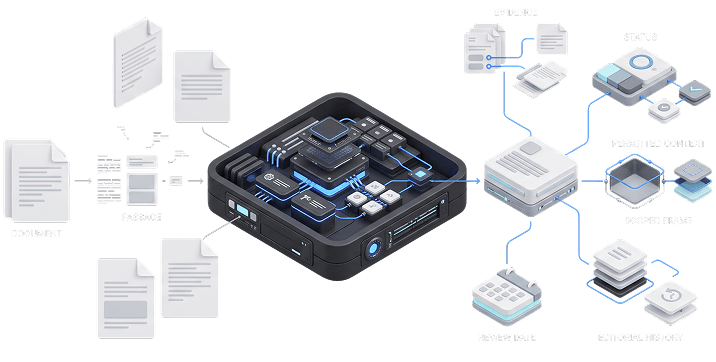
How the AI Chatter can respond to “I’m not sure this will work for us”
- Identify uncertainty instead of treating the message as a rejection
- Review the customer’s previously stated requirements
- Clarify which capability or condition creates doubt
- Adjust the depth and structure of the explanation
- Retrieve relevant approved information from the knowledge base
- Record the unresolved concern and determine the next permitted action
We deploy AI Chatters around your infrastructure and data policy
The deployment model depends on data sensitivity and dialogue-quality requirements; latency, cost and communication volume; integration constraints and the infrastructure available to the client.
Dedicated on-premises
Models and relevant components can run in a client-controlled environment. This gives greater control over data location and model access; request logging, storage and retention; availability and integration boundaries.
Proprietary model infrastructure
Approved proprietary models can be used where their reasoning, language or platform capabilities are appropriate and the client's data policy permits them.
Controlled hybrid routing
Explicit policies can route different tasks and data types to different approved models — for example, processing sensitive context locally while assigning a non-sensitive language task to another model.
What you receive
- Configured Policy Core, Agentic Core, dialogue-state model and completion logic
- Professional persona, behavioral policies, escalation rules and version-controlled instructions
- RAG and memory layer with metadata, retrieval rules, context priorities and restricted knowledge access
- Channel, CRM and business-system integrations with defined API, webhook and structured-output schemas
- Authentication and role-based access; isolated environments and retention controls; audit logging; encryption in transit and at rest
- Deployment documentation, monitoring for latency, errors and data completeness, and an evolution plan
How we build an AI Chatter for your business
Implementation is shaped by your communication channels, historical dialogues and professional role. It also reflects knowledge sources, CRM workflows and expected conversation outcomes.
01
Discover
Map channels and participants, customer intents and business goals, knowledge sources, workflows and expected outcomes.
02
Analyze
Study historical conversations for customer language, recurring scenarios and objections; emotional signals and escalation reasons; decision logic and successful or unsuccessful outcomes.
03
Design
Define the professional role, personality and business goal. Set behavioral policies, knowledge boundaries, required questions, permitted actions and completion criteria.
04
Configure
Build dialogue states and nonlinear paths; memory rules, tool access and escalation conditions; fact-extraction schemas and CRM outputs.
05
Ground
Prepare approved knowledge sources and metadata. Set retrieval and reranking rules, access restrictions, grounding requirements and context priorities.
06
Integrate
Connect communication channels, CRM and business systems through APIs, webhooks, connectors and event callbacks; configure logging and analytics schemas.
07
Validate
Use historical and test dialogues to check long contexts and subject changes; objections and emotional shifts; incomplete information, tool use and non-standard paths.
08
Roll out
Launch a controlled pilot. Track response quality and policy adherence, completion rate, tool usage and CRM updates, plus latency and errors. Then expand and evolve the system.

Questions before
deployment
Here are the questions our clients ask us most often
Do we need to replace our CRM?
No, the AI Chatter connects to your existing CRM through APIs, webhooks or custom integration adapters.
Can the AI Chatter work in WhatsApp, Telegram and Meta platforms?
Yes. It can operate across WhatsApp, Telegram and Meta platforms; website and mobile chats; internal communication systems, subject to available APIs and access permissions.
Can we use local models instead of proprietary models?
Yes, the system can use local models, approved proprietary models or controlled hybrid routing based on your data policy and technical requirements.
How do you make the AI Chatter communicate like our business?
We analyze historical conversations. The findings shape the professional role, personality and policies; dialogue states and knowledge structure; extraction rules and evaluation scenarios.
Can it handle long and nonlinear conversations?
Yes, the system can retain relevant context, move between topics, return to previous questions and select actions according to the complete dialogue state.
How does it interpret emotional and behavioral signals?
It evaluates signals such as uncertainty, frustration, urgency and hesitation together with the customer’s words, interaction history, CRM context and current conversation stage.
Can it use our internal knowledge base?
Yes, the RAG layer can retrieve approved information from internal documentation, policies, FAQs, product materials and other permitted business sources.
What interaction data and system actions can be logged?
The operational database can log messages, states and policy versions; retrieved context, model outputs and routing decisions; tool calls, extracted facts and CRM updates; confidence values, errors and outcomes.
Can its behavior and policies be changed after launch?
Yes. As business processes evolve, you can update persona settings and policies, knowledge sources and goals, tools and conversation paths, and model-routing rules.
Product consultation
Want to automate complex
conversations without
making them feel
automated?
conversations without
making them feel
automated?
We will analyze your historical communication, define the AI Chatter's persona and operational policies, connect the required channels, knowledge sources and CRM, and deploy a governed conversational system around your business process.