Briefs, objectives & delivery requirements
One AI video
pipeline.
Or a complete video
factory for your
content
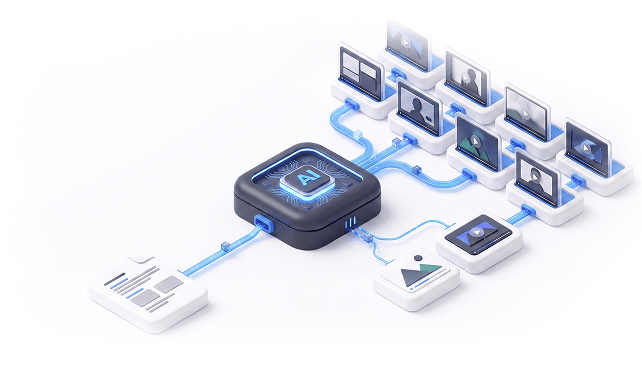
We design and deploy agentic AI systems for individual stages or end-to-end production. They cover brief interpretation and scripting; footage selection, scene generation and digital actors; editing and sound; localization, platform adaptation and publishing.
Modules can run alone or form an AI video content factory. Briefs activate brand and production policies; the system coordinates specialized agents and services. Outputs pass quality gates and editorial review before publication.
Rather than a single-generator interface or subscription bundle, the system is governed: agents manage creative logic; Policy Core enforces brand rules; the integration layer orchestrates models and services; the operator controls tasks, approvals and outcomes.

Why does traditional video production struggle to scale?
- One product launch may need a master video and ad variants; vertical social clips and teasers; localized versions, a product demo and digital presenter; updates to published content
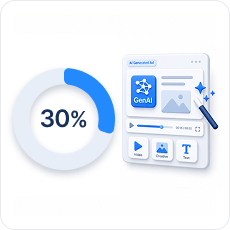
- Although 76% of organizations report faster or higher-volume content production with GenAI, 53% still describe their content supply chain as linear and resource-intensive (Adobe)
- Every new format, platform, language and campaign variant can repeat the complete production cycle
- Late changes can trigger new editing, voice work, scene generation and approval rounds
average project cost in Clutch's video-production agency data; typical duration is about five months

of teams spend more time creating video than promoting it
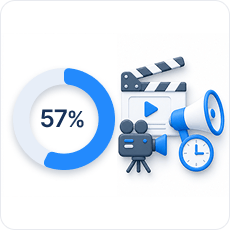
of video marketers used AI tools in 2026, up from 51%; 91% of companies use video and 92% plan to maintain or increase spending
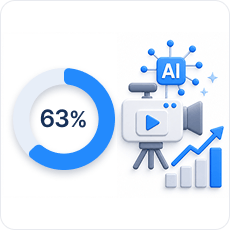
of digital video ads are already created or modified with GenAI; 86% of ad buyers use or plan to use GenAI for video creative
How the system turns a brief into governed video production
The architecture can automate a bottleneck or coordinate a production network across brands, products, formats, markets and channels without replacing existing tools. This control matters because 89% of consumers in Wyzowl's research said video quality affects their trust in a brand.
Complete production coverage
The pipeline parses the brief and analyzes brand, product and audience context. It develops the concept, script, storyboard and shot list, selects or generates assets, and assembles the timeline. It adds titles, subtitles and sound, then localizes, reviews, exports and publishes.
Independent production modules
Scriptwriting, footage selection and scene generation; digital actors, editing and localization; platform adaptation and publishing all use standardized inputs and outputs. Each module can run alone, accept external assets or join the full production network.
Multilevel Policy Core
Executable policies govern brand identity and tone of voice; visuals, typography, logos and wording; characters, environments and actors; video types, platforms and campaigns; markets, languages and source materials; approvals and publication conditions.
Provider orchestration layer
The integration layer converts agent decisions into API calls, routes work and passes scene parameters to appropriate services. It tracks jobs, stores intermediate assets and normalizes formats; handles errors and retries; controls versions and costs. Providers can be replaced without rebuilding creative logic.
Human control where it matters
Clients can approve every stage, only the script and final video, or only high-risk or high-cost operations. Standardized formats can run automatically, including publication, once required checks and approvals pass.
Brief in. Governed video out
The pipeline sits between the systems where video tasks originate and the tools that generate, assemble, approve and publish assets. Data moves in both directions: an operator or critic can return an output to an earlier stage, while every module receives structured input and produces standardized output.
Client inputs
Product, audience & campaign context
Brand assets, references & source materials
Approval rules, platform settings & schedules
AGENTIC AI VIDEO PIPELINE
Brief parsing & project state
Policy & production-route resolution
Script, concept & shot planning
Models, actors, audio & asset orchestration
Assembly, critique & revision
Approval, export & publishing
Business outputs
Master videos & platform variants
Localized & digital-actor versions
Review records & version history
Publication IDs, status & analytics events
Control for operators. Scale for content teams
The operator interface can be an administrative panel or a module in the client's infrastructure; a task-management integration, conversational interface or corporate messenger; a creative workspace or an API. It separates day-to-day production control from cross-brand and cross-channel operational visibility.
For example, one product-launch brief can yield a master video, teaser and vertical social clip; a digital-actor version and localized editions; a product-page video, ad variants and a tutorial, within one project and approval history.
Operator & creative team view
Structured task setup
select video type, product and platform; duration and format; digital actor and applicable policies. Then attach source materials.
Stage-by-stage review
inspect scripts, storyboards, intermediate scenes and the critic's reasons for rejection before approving the next action
Natural-language revisions
enter an ordinary text instruction, compare versions and convert the comment into structured work for the relevant agents and services
Production status
see active stages and generation jobs; errors and retries; intermediate assets, pending approvals and delivery state
Controlled delivery
accept or reject a version, trigger regeneration, send approved video to publishing and track the resulting status
Marketing & content operations view
Multi-brand governance
apply the correct Policy Pack, actor profile and production route by brand and product; market, audience and language; campaign and platform
Production analytics
during the pilot, track production time, manual operations and revision cycles; acceptance rate and integration stability; generation cost, quality, brand alignment and publishing speed
Variant production
create video variants by duration, aspect ratio and platform; localization and CTA; audience, actor and footage combination, all from one project
Business-team support
serve product marketing, customer support, sales enablement and internal education from the same governed infrastructure
Controlled expansion
add formats, products and platforms; languages and digital actors; models, publishing routes and automation levels, without rebuilding the whole system
Revise the
instruction.
Not the whole
production
Because the pipeline is bidirectional, feedback does not have to restart the complete project. The operator, critic, editor, producer or scriptwriter can return a specific output to the relevant module; approved materials, project state and version history remain available to the rest of the workflow.
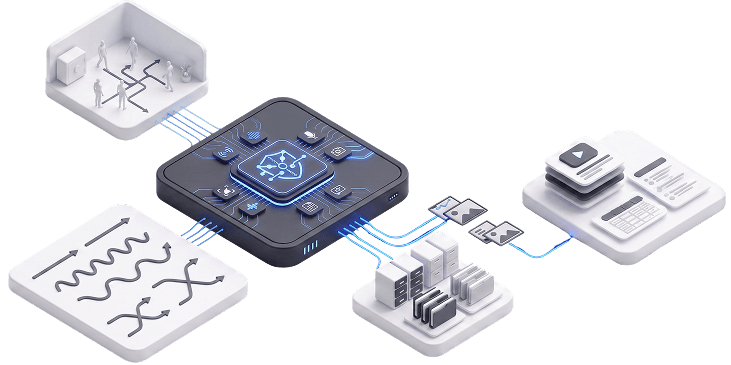
What happens when an operator requests a change
- Converts natural-language feedback into structured tasks for the relevant agents and services
- Revises a script, scene, voice, edit or CTA without automatically rebuilding approved work
- Lets the critic return failed scenes with specific policy, continuity or artifact findings
- Allows the editor to request additional footage, a different cut, pacing change or format adaptation
- Reuses filmed footage, stock, product renders, screen recordings, AI scenes and motion graphics
- Preserves project state, asset versions, review decisions and publishing status through every revision
We configure AI Video Production around your content stack
Deployment reflects video types and volume, quality requirements and model capabilities; API readiness, latency and cost; licensing and reference-material handling; language and data requirements, and existing systems.
Incremental deployment
Start with one bottleneck, such as scriptwriting, footage selection, a digital actor, editing, format adaptation or publishing, and connect more modules after validating the first route.
Provider-flexible model stack
Choose services for text-to-video, image-to-video and video-to-video; scene generation, digital actors and lip-sync; voice, music, stock search, editing and rendering. Assess quality, control, API, speed, cost, licensing and data criteria.
Existing-stack integration
Connect CMS, DAM and PIM; project systems, messengers and storage; asset and stock libraries; social tools, advertising platforms and video hosting; editors, databases, analytics, internal APIs and webhooks.
What you receive
- Configured production modules with defined inputs, outputs and routes
- Agentic creative network with defined roles, sequence and structured handoffs
- Operator interface for task setup, approvals, text revisions, version comparison and publishing control
- Policy Core and content ontology for brands and products; audiences and markets; formats, platforms and approvals
- Integration layer: API adapters and provider routing; job management, retries, callbacks and status tracking; format conversion and asset storage; cost tracking, error handling and version control
- Quality gates, connected output routes, documentation, roles and access rights, monitoring and an evolution plan
How we deploy AI Video Production for your business
The plan follows discovery. Scope and timing depend on automated stages and video types; Policy Core complexity, API readiness and model stack; interface requirements, approvals and publishing integrations.
01
Discover
Map video types, products, brands and platforms; frequency, owners, source materials and tools; editing, versions, approvals and publishing; delays and repeated work. Identify economically viable automation points.
02
Analyze
Review successful and rejected videos, scripts and storyboards; brand guidelines, reference videos and edit projects; editor comments, rejection reasons and performance data; platform rules, actor requirements and templates. Subject to rights and model capabilities, these become positive and negative examples, editing-logic evidence, reusable assets, Policy Core inputs and evaluation data.
03
Model & design
Build the content ontology and architecture for brands, products and audiences; markets and languages; formats, platforms and campaigns; styles, actors and sources; policies, approvals and publication routes. Define manual stages, interfaces, formats, states and errors.
04
Govern
Build the Policy Core from brand identity and tone; script and visual rules; product requirements and platform policies; actor and audio rules; required checks, publication conditions and operator-escalation rules.
05
Select & build
Evaluate models and services for quality, style and control; API access, speed and cost; duration limits, reference support and character consistency; languages, data requirements, licensing and stability. Then configure the agentic network, provider routing and operator interface.
06
Integrate
Implement adapters, job management, retries and callbacks; status tracking, format conversion and asset storage; cost tracking, error handling and version control. Connect review, CMS, website and social destinations; hosting, advertising, DAM and internal destinations.
07
Validate & pilot
Create quality gates for scripts and brand rules; visual continuity and actors; editing, sound and subtitles; formats, artifacts and platforms. Test historical briefs and refine policies and routing. Pilot one controlled video type, platform, brand, product, stage, team or campaign.
08
Roll out & evolve
After validation, enter production with documentation, roles and access rights, operating rules and monitoring. Then add formats, products and platforms; languages, actors and models; publishing routes and automation levels.
Questions before
deployment
Here are the questions our clients ask us most often
Is this simply an integration with one AI video generator?
No. A generator produces individual scenes or assets. AI Video Production manages the brief, script and policies; specialized agents and provider calls; editing, quality gates, approval and publication. Individual services can be replaced without rebuilding production logic.
Can we automate one stage and expand later?
Yes. Every stage is an independent module with its own input and output. Start with scripts, footage selection or digital actors; scene generation, editing or localization; format adaptation or publishing. Connect further modules after validation.
Do we need to replace our current production tools?
Not necessarily. APIs, webhooks or custom adapters can connect the pipeline to current CMS, DAM and asset libraries; task systems, storage and editors; publishing tools. It can act as the orchestration layer around the existing workflow.
How are models, services and brand consistency controlled?
The Policy Core applies brand, video-type and platform rules, plus campaign and conditional rules, throughout production. Providers are assessed for quality, style and control; API access, speed and cost; duration limits, reference support and character consistency; languages, data requirements, licensing and stability.
Can the pipeline combine real footage, AI scenes, digital actors and localized versions?
Yes. Editing can combine filmed footage, stock, product renders and screen recordings; AI-generated scenes, digital actors and motion graphics; photographs, audio and subtitles. Localization can translate scripts, generate or adapt voice, create subtitles and update on-screen text. A real person's appearance or voice requires the client's rights, permissions and source materials. Recurring character consistency depends on the selected stack, references and actor profile.
How are quality, autonomy, revisions and publishing controlled?
Quality gates can check the brief and Policy Core; character and object continuity, visual artifacts and lip-sync; editing rhythm, sound and subtitles; safe zones, duration, resolution, aspect ratio and platform requirements. The client selects human-review points. The Output API publishes only after required checks and approvals; final decisions can remain with a person for critical work.
Product consultation
Want to produce more video
without turning every asset
into a separate production
project?
without turning every asset
into a separate production
project?
We will review your formats, brand policies, tools, volumes, approval process and current production economics; identify the stages with the clearest operational case for automation; and propose a focused AI pipeline or a complete AI video factory.