
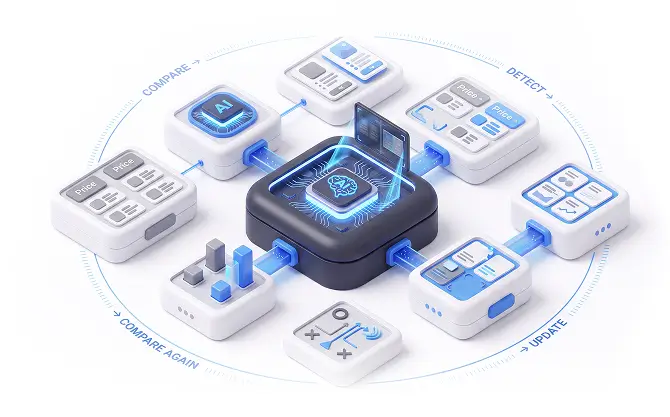
Competitor URLs & priority groups
Turn scattered competitor data into complete commercial intelligence
We build AI pipelines for automated competitor analysis: websites, products and services; pricing and offers; traffic and social activity; approved direct communication by phone, email, messenger or form.
This is a governed agentic workflow, not a web scraper or one-off website prompt. It is configured around the client's methodology, channels, evidence rules, update cycle and output schema.

Why competitor analysis becomes difficult to scale
- Public websites rarely reveal negotiated pricing, qualification logic or follow-up
- Product, traffic, social and communication evidence sits in separate systems
- Manual methods vary between analysts and prevent consistent comparison
- Undated, unweighted sources make findings difficult to verify or refresh
of teams say at least half of sales opportunities are competitive

average weekly CI workload reported by dedicated specialists

of respondents struggle to collect competitive data quickly enough

use static sources / cannot reliably determine the freshness of all data

How the pipeline turns competitor data into comparable intelligence
A modular workflow applies consistent research logic across companies; each stage can be enabled, replaced or configured by product, GEO and decision.
Brief & orchestration
The brief defines competitors, products and ICP; fields, questions and channels; evidence, reporting and update frequency. The orchestrator creates parallel workers, schedules and tracks tasks, retries failed stages and inserts review points.
Website & offer intelligence
Scanners inspect product, pricing and conversion pages; documentation, content, legal, contact and regional pages; metadata, sitemaps and changes. They structure products, audiences and offers, restrictions and proof, and sales routes.
Communication agents
Approved voice, email, messenger and form scenarios request commercial information and manage follow-ups. They capture qualification and response time, process files and reconcile received terms with public claims.
Digital footprint intelligence
Social modules analyse platforms and cadence, themes and offers, engagement and complaints, product announcements and messaging changes. External traffic sources add estimated volume and GEO; acquisition channels and landing pages; search and device signals.
Evidence governance
Raw pages, screenshots and transcripts, emails, files and social data retain source and timestamp; freshness, method and confidence; corroboration and contradiction status. Traffic figures remain labelled as estimates.
URLs in. Evidence- backed competitor intelligence out
The AI Workflow Orchestrator assigns each competitor to an independent worker and coordinates scanners, data providers and communication agents. Evidence is normalised, reconciled and analysed before reports and structured events return to client systems.
CLIENT INPUTS
Products, services, GEO & ICP
Research fields, questions & channels
Report schema, schedule, callback URL & metadata
COMPETITOR ANALYSIS AI PIPELINE
Brief, queue & task planning
Website, offer & contact extraction
Traffic, social & communication agents
Evidence, freshness & contradiction control
Entity resolution, scoring & comparison
Reports, output API & client workflows
Business outputs
Competitor profiles, prices & commercial terms
Source links, evidence & communication logs
Comparison matrices, risks & opportunities
Status, reports, change events & workflow updates
One evidence model. Different business decisions
Views built from the same source-linked evidence serve product management and product marketing; strategy and market intelligence; sales enablement, growth and business development; investment and leadership teams. Analysts retain responsibility for strategic interpretation, sensitive conclusions and decisions.
PRODUCT & MARKET VIEW
Company & offer profile
products, services, packages and features; audiences and GEO; restrictions, evidence and sales model
Pricing & commercial terms
public prices and received quotes; billing models, discounts and fees; minimum terms and discrepancies
Positioning
value promise, differentiation, customer problem, recurring messages and claimed advantages
Customer journey
CTA and forms; response time and qualification; sales questions and documents; follow-up and next step
Hypothesis testing
evidence for new features, tiers and bundles; segments and channels; GEO and go-to-market choices
STRATEGY & COMMERCIAL VIEW
Executive summary
findings and differences; threats and opportunities; recommended actions, confidence and data gaps
Comparative matrix
product, price and offer; capability depth and service model; onboarding, sales process and customer experience
Traffic & acquisition
estimated traffic, GEO; organic, paid, referral, direct, social channels; landing pages and visible campaigns
Social & content intelligence
platforms and publishing cadence; themes and offers; engagement, user questions, complaints and announcements
Change history
versions changes to prices and packages; pages and campaigns; team and vacancies; positioning, content and documentation
Compare the
commercial
reality. Not just
the price page
A public price page shows only the published offer. The pipeline links it to direct responses, documents, traffic and content evidence, preserving dates and confidence so teams can see where the commercial reality differs.
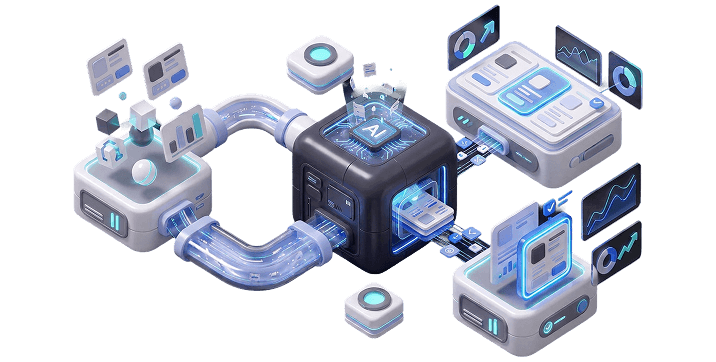
What a basic pricing comparison can miss
- The quote includes setup fees or a minimum contract term
- Discounts appear only after qualification or follow-up
- Regional pages show different packages, terms or availability
- The sales team asks company-size questions before disclosing price
- A received proposal contradicts the current public offer
- Source dates reveal which evidence is current or requires review
We configure Competitor Analysis AI around your research environment
Configuration reflects competitors, products and GEO; evidence and communication rules; update cycle and review process; output schema, integrations and available infrastructure.
Client-controlled deployment
Relevant components can run on-premises within client-controlled infrastructure, increasing control over configuration, evidence, access, integrations and operation. Selected channels and data providers may remain external.
Governed communication
Before launch, define sender identity, open commercial contacts and permitted questions by market and channel; follow-up and recording rules; stop conditions and human review.
Modular evolution
Documented interfaces and templates let client teams add research fields, sources and scenarios; scoring, report types and output fields; competitor groups and schedules, without a development request for every hypothesis.
What you receive
- Configured AI workflow engine for task planning, parallel workers, retries, schedules and review points
- Website, offer and contact modules; social and traffic; voice, email and messenger; file processing
- Research ontology, source policies, confidence rules, scoring and configurable output schema
- Evidence layer with raw artefacts, timestamps, freshness, contradictions and analytical trace
- API and webhook integrations: CRM, BI and DWH; dashboards and knowledge bases; research portals and data lakes
- Client interface, templates, documentation, training, pilot configuration and evolution plan
How we deploy Competitor Analysis AI for your business
Implementation moves from business decisions to controlled collection, communication, comparison, delivery and updates.
01
Define
Map decisions on product, pricing and positioning; GEO, sales and acquisition; roadmap or investment. Then prioritise direct, indirect, substitute and regional competitors.
02
Formalise
Define products and ICP; fields, questions and channels; required evidence, comparison format and report structure; update frequency and completeness criteria.
03
Map
Approve websites, pricing pages and social networks; public documents, traffic providers and search; advertising libraries, review platforms and news; public databases and communication channels.
04
Model
Create the competitor ontology and output schema; scoring, weighting and confidence rules; comparison matrix, gap analysis and change model.
05
Configure
Set up the task planner and parallel workers; schedules, retries and status tracking; error handling, source policies and human-review points.
06
Build
Connect website, offer and contact collectors; social, traffic and file collectors. Set voice, email, messenger and form scenarios with permitted actions and stop conditions.
07
Validate & integrate
Test a limited competitor group for extraction, contact accuracy and response handling; traceability and report consistency; processing time and cost. Then connect CRM, BI, DWH, dashboards or research portals.
08
Launch & evolve
Start scheduled production, update profiles and change histories, and train client staff. As requirements evolve, add sources, channels and GEO; scoring, reports and integrations.

Questions before
deployment
Here are the questions our clients ask us most often
Can relevant components run in our infrastructure?
Yes. Relevant pipeline components can run within client-controlled infrastructure, while selected communication channels and external data providers may remain external dependencies.
Is this ordinary competitor website monitoring?
No. Website monitoring is one module alongside product, pricing, traffic, social, content and approved direct-communication analysis.
Can the system analyse several competitors at once?
Yes. The orchestrator assigns each competitor to an independent worker so research can run in parallel under the same methodology and output schema.
Can agents contact competitors directly?
Yes, via open commercial contacts and client-approved voice, email, messenger or form scenarios. Sender identity and questions, recording rules, follow-up and stop conditions are defined.
How are estimates and conflicting evidence handled?
Each fact can retain source and timestamp, method and freshness, corroboration, confidence and contradiction status. External traffic data stays labelled as estimated; unresolved conflicts can enter human review.
Can our team change reports and research after launch?
Yes. Configured interfaces and templates can let authorised staff add fields, sources and scenarios; scoring, output schemas and competitor groups. They can schedule full or selected-module updates and deliver results to connected systems.
Product consultation
Need the complete
picture behind a
competitor's offer?
picture behind a
competitor's offer?
We will configure the pipeline for your competitors, products, GEO and ICP; evidence requirements and working environment. It will automate collection, approved communication and comparable reporting for product, marketing, sales and leadership.