
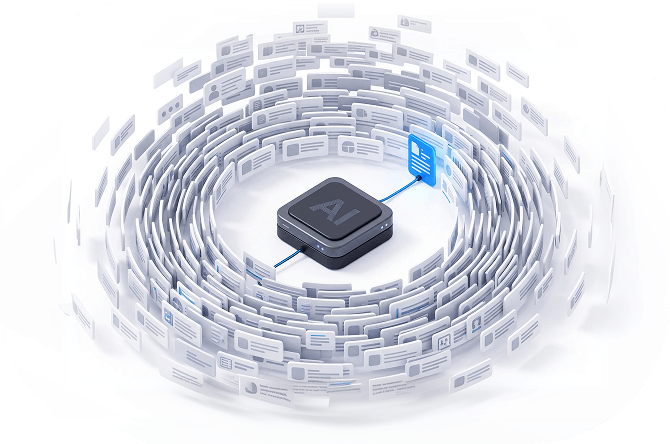
Keywords, query groups, GEO & languages
Turn market signals into decisions. For marketing, content and product
Custom software and agents continuously collect, normalize and analyze search, social and video data; trend and publication data; licensed and authorized client data. Reusable runs define keywords, GEO and language; audience and product; filters, timing and output.
Raw data and reproducible snapshots ground specialized agents producing briefs, trend reports, content plans and product recommendations. It is a governed research layer connected to business workflows—not a link aggregator or general AI chat.

Why does market intelligence become difficult to scale?
- Search, social, video and industry signals remain split across tools
- Reports lose relevance as demand, language and platform behavior change
- Teams repeat similar research with different filters and methods
- Raw evidence and decision context are difficult to reproduce or update
revenue uplift commonly associated with personalization; 10-30% potential marketing-spend efficiency

median annual pay for US market research analysts in May 2025

of consumers expect personalized interactions; 76% are frustrated when they do not receive them

of marketers report difficulty keeping pace with changing customer behavior
How the system turns market signals into decision-ready intelligence
One workflow supports recurring research across products, markets, languages and channels without replacing analytics, content or product systems.
Search-run design & template library
Operators define scope, sources, outputs and schedules; save templates; correct categories, merge entities and route records for review.
Orchestration & source connectors
Scheduled or queued runs send queries to parallel workers. Connectors manage access, pagination and rate limits; mapping, retries and retrieval policies.
Raw data, provenance & lineage
Raw content stays separate from analysis. Metadata, retrieval context, versions and links to findings are preserved for reprocessing, comparison and audit.
Normalization & noise control
It cleans, deduplicates and processes multilingual data; extracts entities, topics and intent; normalizes engagement and analyzes time series. Clustering and noise filtering create a common structure.
Reproducible snapshots & comparisons
Snapshots preserve sources, scope and entities; clusters, segments, engagement and provenance. They support comparisons across periods, languages, platforms, categories and markets.
Search run in. Market intelligence out
Tasks enter through the operator interface or API. The Search Run Manager selects sources and coordinates collection. Provenance is recorded as data passes through normalization, clustering and snapshot generation; specialized agents then return structured outputs to client systems.
CLIENT INPUTS
Audience, product, category & research question
Platforms, sources, date range & filters
Output type, schedule, callback & metadata
MULTI-SOURCE MARKET INTELLIGENCE SYSTEM
Search-run planning & source selection
Connector collection & task orchestration
Raw data, metadata & provenance
Normalisation, clustering & noise filtering
Snapshots & specialized agentic analysis
Reports, output API & workflow delivery
Business outputs
Topic clusters, trend & demand signals
Content plans & marketing recommendations
Segments, niches & audience questions
Product insights, reports & dashboard events
One intelligence layer. Different business decisions
Digital agencies and multi-brand content teams; SEO and SMM specialists; e-commerce businesses, product and growth teams; market researchers and organizations entering new GEOs can share one governed evidence base.
MARKETING & CONTENT VIEW
Demand & intent map
search interests and query changes; user problems and popular questions; demand gaps and changes in audience language
Trend & channel signals
growth, decline and seasonality; early signals and platform differences; content formats and audience engagement
Segment map
needs and motivations; awareness and selection stage; channels and terminology; product fit and communication recommendations
Content intelligence
covers article topics, clusters and briefs; social and video ideas; newsletter themes, formats, CTAs and priority scores
Campaign planning
audience briefs, message maps, channel recommendations, seasonal opportunities, creative territories and advertising hypotheses
PRODUCT & STRATEGY VIEW
Market brief
market status, demand structure and period changes; GEO and language differences; opportunities, risks, evidence and confidence
Niche opportunities
shows underrepresented topics, growing subcategories and unmet demand; low content saturation, use cases, risks and validation questions
Product intelligence
needs and rejection reasons; feature ideas and positioning signals; roadmap questions, research prompts and proposed experiments
Comparative monitoring
compare periods, GEO and languages; platforms, segments; keyword groups, categories and sources
Executive delivery
trend reports, weekly intelligence briefs, product action plans, presentation structures and dashboard-ready JSON
Identify a trend.
Not just a spike
A burst of engagement on one platform is not evidence of a sustained market trend. Under the configured methodology, the system evaluates duration and growth; independent signals and source distribution; GEO, audience context and historical behavior.
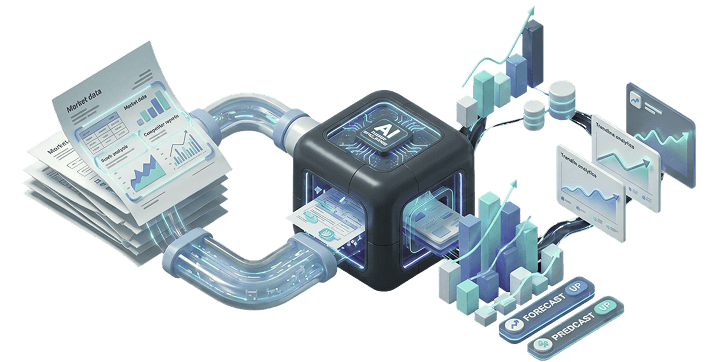
What the system checks before classifying a signal as a trend
- The signal persists beyond a short-lived information spike
- Growth is measured against previous periods and the historical baseline
- Independent sources and platforms show related movement
- Distribution across GEOs, languages and audience segments is considered
- Engagement, recurrence and connected themes support the pattern
- Client-defined criteria and human review determine the final status
We deploy Market Intelligence AI around your sources and workflows
The system is configured around source availability, data policies, processing volume, update frequency, integration requirements and the infrastructure available to the client.
Client-controlled deployment
Relevant software, raw-data, normalization and agentic components can run in client-controlled infrastructure where the agreed architecture supports it. External platforms, licensed databases and provider APIs may remain dependencies.
Source-specific controls
Each connector follows its approved source’s available access method and authorization; filters, pagination and rate limits; field mapping, retention and retrieval policies.
Controlled analyst workflow
The teams and decisions the system supports shape its roles and review points, schedules and source policies, confidence rules and output formats.
What you receive
- Operator interface with search-run builder, template library, schedules, data review and run comparisons
- Source connectors and orchestration: queues, priorities and parallel workers; rate limits and retries; callbacks and recovery
- Separate raw-data and provenance layer with retrieval context, versioning, lineage and reprocessing
- Normalization pipeline: languages, entities, topics and intent; engagement and clustering; time series and noise control
- Reproducible input snapshots; custom agents for trend and demand, segment and niche, content and product intelligence
- Input and output APIs for BI, DWH and dashboards; CMS and CRM; content, product and research workflows
How we deploy Market Intelligence AI for your organization
Implementation moves from business decisions and research use cases through source integration, data preparation, agentic analysis, validation and production.
01
Discover
Map users and decisions, repeated research and current reports, delays, required outputs and update cycles.
02
Define use cases
Specify demand, trend, segment and niche scenarios; content, campaign and product; GEO, category and executive, with input and output schemas.
03
Map sources & search runs
Select search, social and video sources; trend, publication, licensed and internal sources. Define queries, GEO and languages; periods, filters, exclusions and schedules.
04
Build connectors & data layer
Set access and field mapping; pagination, rate limits, statuses and retries. Configure raw-data storage, metadata and provenance; versioning, retention and permissions.
05
Normalize & snapshot
Set cleaning and deduplication, language and translation rules; entity, topic and intent rules; clustering, time-series, engagement and noise rules. Create comparable snapshots.
06
Configure agents & rules
Build the required agents with business teams. Define trend, segmentation and prioritization logic; confidence, output and human-review logic.
07
Interface, API & validate
Create run, review and comparison tools; snapshot and export tools. Define APIs, webhooks and callbacks; errors, idempotency and permissions. Test historical research.
08
Pilot, integrate & evolve
Pilot a bounded use case, monitor quality and manual effort, and connect business workflows. Then add sources, GEOs and languages; agents, outputs and rules.

Questions before
deployment
Here are the questions our clients ask us most often
Can relevant components run in our infrastructure?
Yes. Relevant software and data-processing components can run in client-controlled infrastructure under the agreed architecture, while external platforms, licensed databases and third-party APIs may remain outside that environment.
Which sources and filters can the system use?
It can use approved search, social and video sources; trend, publication, licensed and internal sources, with filters and operators available through each connected API, interface or connector.
Can search runs be scheduled and compared?
Yes. Runs can start manually, on a schedule or by an event. Versioned snapshots support comparisons across periods, GEOs and languages; platforms and segments; categories and query groups.
How is it different from monitoring or entity research?
Monitoring counts mentions. Market Intelligence AI analyses aggregated signals around a market question, while Competitor Analysis AI and OSINT Research Systems focus on specific companies or entities.
Can it create content plans and product recommendations?
Yes. Agents can produce topics, briefs, content priorities and product hypotheses, but product recommendations remain inputs for customer research, economic validation and human decision-making.
Does the system replace a market research analyst?
No. It automates repeatable collection, normalization, clustering, snapshots and standard outputs; analysts still frame complex questions, verify material conclusions and make strategic decisions.
Product consultation
Want current market
signals to guide
marketing and product
decisions?
signals to guide
marketing and product
decisions?
We will map your products, markets and audiences; sources, research questions and workflows. We then configure a software and agentic system that turns external data into market briefs, trend reports, content plans and product actions.