

Object, name & known identifiers
Turn Open-Source Data into Verified Intelligence
We build custom agentic OSINT systems that search, verify and structure data on people, organisations, projects, domains and related entities.
Configured by GEO and language, registries and object type, questions and sources, they resolve identities and map relationships, build timelines and return evidence-backed results to business systems.
Unlike a search bar or one-off prompt, this governed infrastructure applies source policies, preserves evidence provenance and flags uncertain matches for analyst review.

Why does manual OSINT become difficult to scale?
- Analysts repeat the same collection steps across disconnected tools
- Aliases, transliteration and local identifiers increase false-match risk
- Freshness and contradictions are difficult to track without provenance
- Evidence can be lost between discovery, verification and reporting
organisations finding candidate-data discrepancies in the preceding 12 months
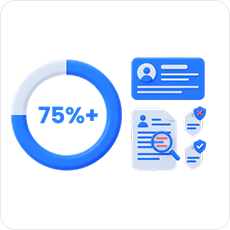
organisations reporting third-party financial or reputational harm over the preceding three years

of one bank team's time spent searching before process centralisation

faster time to insight reported in OSINT vendor benchmarks

How the system turns an OSINT question into verified intelligence
Each task becomes a controlled workflow for source-specific collection, matching, verification, analysis and review.
Research brief & operator interface
Custom forms capture object type and known identifiers; GEO, languages and time range; questions, source requirements and report schema; priority and case metadata. Operators see status, unresolved matches, review queues and section readiness.
GEO Packs
GEO Packs define local languages and transliteration; name, address and identifier formats; legal forms, registries and platforms; API availability and reporting standards for the relevant information environment.
Source Policy Packs
Each Source Policy Pack defines purpose, access and fields; query order, depth and authorisation; evidence retention, freshness and reliability; cross-checking, conflict handling, stop conditions and report-use rules.
Collection agents
Separate agents search open or licensed databases, registries and websites; public social data and permitted messenger sources; publications, documents and images; APIs and authorised client systems.
Verification & entity resolution
Cross-source checks assess identifiers, freshness, relevance and contradictions. Normalisation, translation and transliteration; deduplication, alias resolution and relationship mapping classify matches by confidence. Uncertain entities stay separate for analyst review.
Research object in. Reproducible intelligence out
Tasks enter through an operator interface or API. The orchestrator assigns sources and parallel workers. Evidence provenance is recorded alongside normalisation, entity resolution and verification before results return to client systems.
RESEARCH INPUTS
Questions & source policy
GEO, languages & time range
Report schema, priority & metadata
AGENTIC OSINT RESEARCH SYSTEM
Task planning & source selection
Database, registry, web & social collection
Messenger, document, image & API processing
Evidence provenance & source controls
Normalisation, entity resolution & verification
Reports, review, output API & workflows
Business outputs
Resolved entities, aliases & relationships
Evidence, confidence, contradictions & gaps
Verified facts, timelines & risk indicators
Reports, status, analyst notes & updates
One evidence model. Different business decisions
One governed evidence model serves OSINT providers, HR and recruitment; third-party assessment and corporate risk; compliance, security and enterprise research under a shared methodology.
ANALYST & REVIEWER VIEW
Resolved identity
names, variants, transliterations and aliases; identifiers, addresses and contacts; domains and attribution evidence
Source map & evidence
source type and retrieval date; reliability, policy and verification status; saved material and the linked finding
Timeline
events and role changes; registrations and reorganisations; publications, movements, digital-footprint changes and relationships
Relationship graph
people and organisations; addresses, domains and contacts; projects, events, documents and connection confidence
Conflict & review queue
inconsistent facts and unsupported claims; timeline gaps and unresolved matches; missing evidence and analyst actions
BUSINESS & WORKFLOW VIEW
Executive summary
verified findings, discrepancies and key relationships; confidence and data gaps; follow-up questions and recommended next actions
Candidate & workforce research
public professional data, supplied information, affiliations, repeatable checks and standardised authorised HR reports
Third-party profile
partners, suppliers, clients and counterparties assessed for onboarding, periodic review, discrepancies, relationships and risk workflows
Portfolio operations
mass checks under one methodology, separated projects and permissions, recurring research and consistent comparison across analysts or teams
Structured delivery
returns resolved entities, facts and evidence; status, reports and events to CRM, HRIS, ERP, BI, DWH or case systems
Resolve the
entity. Not just
the name
A matching name is not proof of identity. The system compares identifiers, contacts and domains; roles, dates and relationships; images and documents before records can be merged or a conclusion can enter the report.
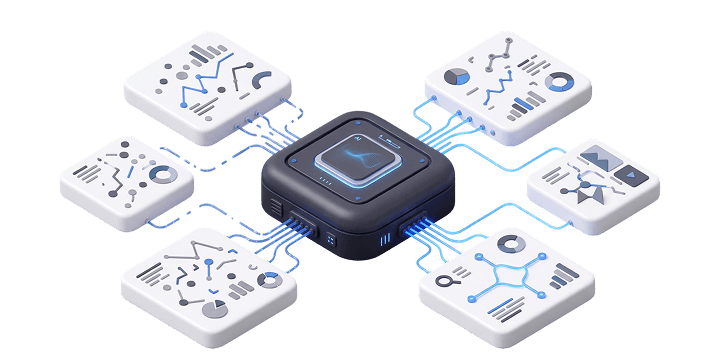
What the system checks before merging two records
- Full, shortened and transliterated names align
- Email, phone, address or domain provides supporting identity evidence
- Company, role and dates fit the same chronology
- Images or documents corroborate identity, not just resemblance
- Conflicting identifiers remain visible instead of being overwritten
- Weak matches stay separate and enter analyst review
We configure OSINT Research Systems around your sources and controls
Deployment reflects source access, evidence storage, compute, role separation, integrations and available client infrastructure.
Client-controlled deployment
Relevant components can run in client-controlled infrastructure, increasing control over configuration, evidence, access and operation. External websites, licensed databases, platforms, search providers and OSINT APIs may remain dependencies.
Role-based research controls
Permissions govern projects, objects and sources; raw data, approvals and policies; exports and integrations. Audit records cover tasks, source use, entity merges and review decisions.
Connector-based expansion
Each connector defines schema, authorisation and operations; field mapping, limits and policy; logging, health and update rules, avoiding a full pipeline redesign.
What you receive
- Operator interface with forms, queues, statuses, evidence and entity views
- Agentic orchestrator: source selection and parallel workers; scheduling and retries; callbacks and recovery
- GEO Packs, Source Policy Packs and configurable object, input and report schemas
- Evidence and provenance store: raw artefacts and timestamps; freshness and reliability; access context and hashes
- Normalisation, entity resolution and verification core with contradiction and analyst-review workflows
- Backend services: access, accounts and credentials; audit logs and monitoring; source health and integrations
How we deploy an OSINT Research System for your organisation
Implementation moves from research decisions through source governance, identity modelling, controlled automation, validation and production.
01
Discover
Define object types, questions and decisions; depth and users; sufficient outcomes and post-report actions.
02
Design
Create object-specific schemas, GEO Packs, identifier and language rules, source maps and report templates.
03
Govern
Set Source Policy Packs, evidence retention, freshness and reliability; access rights, review conditions and permitted use.
04
Model
Define entities, identifiers and aliases; temporal properties and relationships; confidence and rules for merging or separating records.
05
Build
Connect approved sources. Create the agentic workflow and operator interface; queues and review tools; backend controls and audit history.
06
Integrate
Define APIs, webhooks and callbacks; status and error schemas; idempotency, system permissions and client-workflow connections.
07
Validate & pilot
Compare historical cases for identification and completeness; false matches and missed relationships; confidence and report quality; time and cost. Then run a controlled pilot.
08
Roll out & evolve
Launch production queues, train teams and schedule updates. Add GEO and object types; sources and policies; templates, scoring and integrations.

Questions before
deployment
Here are the questions our clients ask us most often
Can relevant components run in our infrastructure?
Yes. Relevant components can run within client-controlled infrastructure, while external websites, licensed databases, platforms and third-party APIs may remain outside that environment.
Which sources can the system use?
Under defined Source Policy Packs, the system can use approved public or licensed databases, registries and websites; social platforms and open or permitted messenger sources; documents, APIs and authorised client systems.
Can it research both people and organisations?
Yes. Separate schemas, sources and matching rules can cover candidates, employees and clients; partners, suppliers and counterparties; companies, projects, domains and related entities.
How does the system adapt to a specific country?
A GEO Pack defines local languages and transliteration; names, addresses, legal forms and identifiers; registries, platforms and available APIs; source rules and report standards.
What happens when matches or sources are uncertain?
The system can keep entities separate, preserve conflicting versions with their evidence and confidence, record unresolved gaps and route the issue to analyst review.
Does the system replace an OSINT specialist?
No. It automates repeatable collection, processing, matching, evidence preparation and report assembly; specialists still frame the task, resolve material ambiguity and approve critical conclusions.
Product consultation
Need OSINT to work
as a repeatable
research system?
as a repeatable
research system?
We will map your object types, GEO, sources, methodology and output requirements, then configure an agentic OSINT system with controlled collection, evidence provenance, entity resolution, analyst review and enterprise integration.